
„My tooth hurts or is sensitive“
When a tooth hurts or is sensitive
Sensitivity to cold, a short sharp pain when you bite, or a dull ache that keeps coming back – these are all signs that a tooth needs attention. The cause is not always decay: sometimes it is a receding gum, worn enamel or an old filling that has cracked. That is why we look for the reason first and only then suggest treatment. If the pain doesn't stop, wakes you at night or you notice swelling, book an emergency appointment – we keep a few slots free every weekday for cases like this.
Why it usually happens
- Decay that has reached close to the nerve
- Worn enamel or receding gums that expose the sensitive part of the tooth
- A cracked or old filling with new decay forming underneath
- An inflamed nerve or an infection at the tip of the root
- Clenching and grinding, most often at night
What we can do
Filling
When decay is caught in time, we remove the damaged part and fill the tooth with tooth-coloured composite. Any sensitivity afterwards usually settles within a few days to two weeks.
Filling (composite)6,000 to 9,000 RSDBook
Root canal treatment
If the nerve is inflamed, a filling is no longer enough. We clean and seal the canals inside the root, so the tooth stays in your mouth instead of being taken out. The technical term for this is endodontics.
Root canal treatment12,000 to 24,000 RSDBook
Protecting sensitive spots
When the cause is not decay but an exposed tooth neck – the part right next to the gum – a fluoride varnish at the clinic, a toothpaste for sensitive teeth and a softer brush often help. The dentist will judge whether that is enough or whether a protective filling is needed.
First check-up and treatment plan4,500 RSDBook
Emergency appointment
If the pain keeps you awake or your cheek is swollen, don't wait for a regular appointment. We ease the pain first and make a treatment plan once the worst has passed.
Emergency: pain, swelling, broken tooth4,000 RSDBook
How it works with us
- 01
Talk and examination
We ask when it hurts, for how long and what the tooth reacts to. Then we examine the tooth and the gum around it.
- 02
Imaging
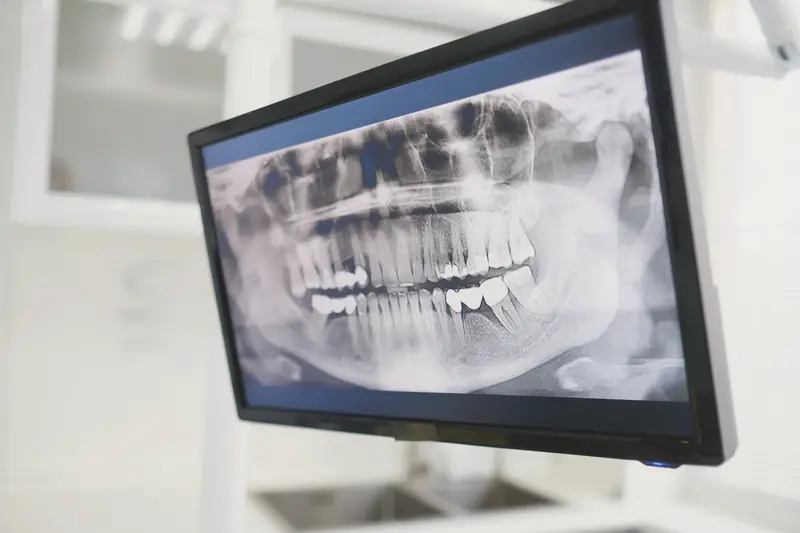
With the intraoral camera and, if needed, an X-ray, we see how deep the damage goes. We show you the images on screen.
- 03
Explanation and choice
The dentist tells you what they suggest, what it costs and what happens if you wait. The decision is yours.
- 04
Treatment with local anaesthetic
Before we start, we give you a local anaesthetic, so most patients feel only pressure. If you need a break, raise your hand and we stop.
How long it takes
A filling is usually done in one visit of about an hour, and root canal treatment takes one or two visits of 90 minutes each.
After treatment
After a filling you can eat as soon as the anaesthetic wears off, usually within two to three hours. After root canal treatment the tooth may be tender to bite on for a few days; this is expected and usually settles on its own. Get in touch if the pain gets stronger after a few days, if swelling appears, or if the tooth seems to hit first when you bite.
What it costs
A filling costs RSD 6,000–9,000, depending on its size and how many surfaces of the tooth it covers. Root canal treatment is RSD 12,000–24,000 per tooth, because front teeth usually have one canal and molars three or four. After root canal treatment a tooth often needs a crown, and we tell you this in advance.
- First check-up and treatment plan4,500 RSD
- Emergency: pain, swelling, broken tooth4,000 RSD
- Filling (composite)6,000 to 9,000 RSD
- Root canal treatment12,000 to 24,000 RSD
Common questions
Does sensitivity to cold always mean decay?
Not always. It is often an exposed tooth neck or worn enamel. At the examination we check what is causing it in your case.
Does root canal treatment hurt?
It is done under local anaesthetic, so most patients feel pressure rather than pain during treatment. For a few days afterwards the tooth may be tender to bite on.
The pain went away on its own. Do I still need to come in?
Yes. Pain sometimes stops because the nerve has died, and an infection can progress without any pain. It is better to look at the tooth while there are still more ways to treat it.
This text is a general explanation and not a substitute for a check-up. Your dentist will tell you what is best for you after examining you.
First time with us?
Choose “First check-up and treatment plan”. If you are not sure, call us.