Treatment
Implant or bridge: how we decide together
Both work well when they are properly planned. What we check before deciding, how long each one takes and what the price depends on.
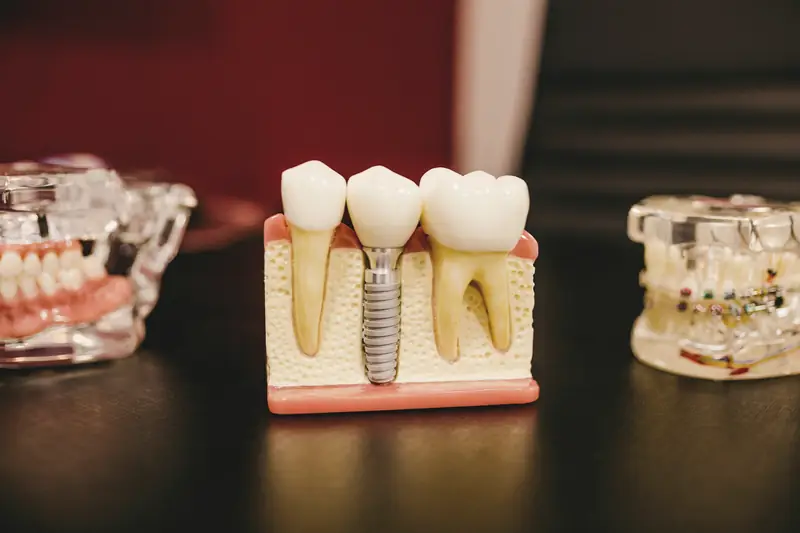
When a single tooth is missing, patients most often ask me which is better, an implant or a bridge. The honest answer is: it depends. Both work well when they are properly planned. They differ in what they ask of your neighbouring teeth, your bone and your time.
What each one is
An implant is a small screw, usually made of titanium, that is placed in the bone where the tooth was lost. Once the bone has fused around it, a crown is fitted on top. The neighbouring teeth are left untouched.
A bridge rests on the teeth on either side of the gap. Those teeth are filed down and given crowns, with an artificial tooth between them. A bridge doesn't come out, and no surgery is needed.
There is also a removable partial denture. It costs less, but most people find it less comfortable. Sometimes it is reasonable to do nothing at all, for example when the missing tooth is the last one in the row and doesn't affect your chewing. We talk about that openly too.
What we check before deciding
- The neighbouring teeth. If they are healthy, filing them down for a bridge is a permanent cost to them. If they already have large fillings or crowns, a bridge may be the more sensible choice.
- The bone. A 3D scan (CBCT) shows how much bone there is and where the nerves and sinuses are. If there isn't enough bone, bone grafting is needed before or during implant placement.
- General health. Uncontrolled diabetes, smoking and some osteoporosis medicines slow healing and increase the risk. That doesn't always mean “no”, but it changes the plan.
- Habits and oral hygiene. Implants and bridges both need thorough cleaning. Inflammation of the gum and bone can develop around an implant, much as it can around a natural tooth.
It is also worth knowing that an implant sometimes doesn't fuse with the bone. It is then removed, and after healing a new one can usually be placed.
How long it takes and what it costs
A bridge is usually finished in two to three visits, over about two weeks. An implant takes longer: after placement, the bone usually takes three to six months to heal, and only then is the crown made. With bone grafting, it can take longer.
An implant with a crown costs from 95,000 to 140,000 RSD per tooth, depending on the implant system and whether bone grafting is needed. Bone grafting is priced separately, from 25,000 to 60,000 RSD. A bridge is usually priced per unit, like crowns: a porcelain-fused-to-metal crown is 16,000 RSD, and a zirconia crown from 30,000 to 38,000 RSD. That is why a three-unit bridge usually costs less than an implant, but it means filing down two teeth.
How we make the decision together
At the consultation I show you the scan and explain what I see. When a bridge is a good option, Dr Mila Ristić, our specialist in prosthodontics, joins the conversation. You get both options in writing, with a price range and the number of visits, so you can read them calmly at home.
Before you decide, it helps to answer three questions for yourself: how important it is to you that your neighbouring teeth stay untouched, how many visits you can fit in, and what budget works for you now and in a few months' time. There is no wrong answer, only the one that suits you better.
The implant consultation with a 3D scan takes 45 minutes and costs 6,500 RSD.