Aesthetics
Clear aligners or fixed braces: how to choose
How they differ in wear, appearance, hygiene and price, and why a retainer matters after any kind of orthodontic treatment.
Adult patients most often ask me whether they can have clear aligners instead of “wires”. Often they can. But the choice depends not only on what is less visible, but also on how your teeth need to move and which way of wearing them suits you.
How each one works
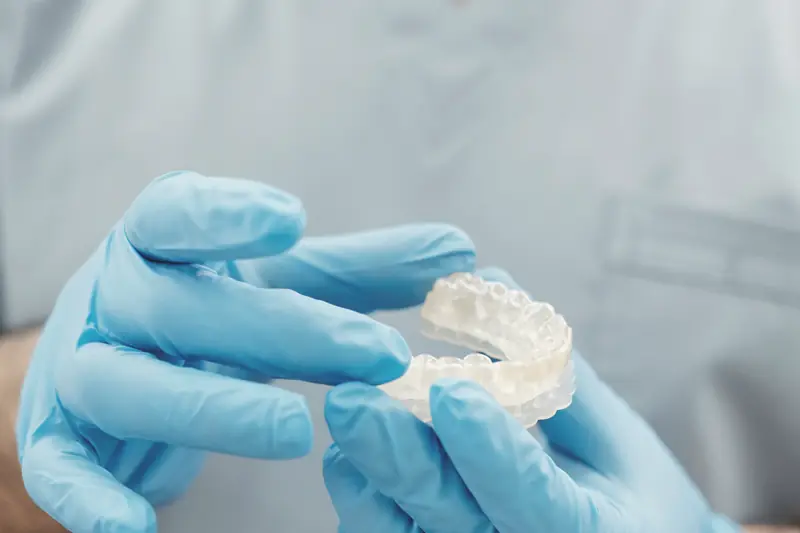
Clear aligners are thin, transparent trays made according to a digital plan. Each new one is slightly different and moves the teeth by a fraction of a millimetre. On some teeth we bond small tooth-coloured bumps, called attachments, so the aligner has something to grip.
Fixed braces are brackets bonded to the teeth and a wire that connects them. The braces stay on your teeth all the time, and we adjust them at check-ups.
The main differences
- Wear. Aligners are worn 20 to 22 hours a day and only come out for eating and brushing. If you don't wear them enough, your teeth don't move according to plan. Fixed braces work all the time, whatever your discipline.
- Appearance. Up close, aligners are barely noticeable. Brackets are visible.
- Hygiene. You take aligners out, so you brush and floss as usual. Food easily gets caught around brackets, and brushing takes longer.
- Food. With aligners you can eat anything, but you brush your teeth after eating before putting them back in. With fixed braces you need to avoid hard and sticky food, such as nuts, toffee and hard bread crusts.
- Complexity. For mild and moderate cases, aligners are usually just as good a choice. For some large movements and more serious bite problems, fixed braces give better control.
- Check-ups. With aligners you usually come in for check-ups less often than with fixed braces.
Duration, price and what comes after
In adults, treatment usually takes one to two years, and a more precise answer is only possible after an examination and X-rays. Clear aligners cost from 280,000 to 480,000 RSD for the whole treatment, depending on complexity and the number of aligners. Fixed braces cost from 140,000 to 190,000 RSD per jaw.
After braces. This is the part people talk about least, but it matters. Teeth tend to move back to where they were. That is why every orthodontic treatment is followed by retention: a thin wire bonded to the inside of the teeth, a clear retainer worn at night, or both. Without a retainer, part of the result can be lost, and that applies to aligners and fixed braces alike.
What can help you decide
Ask yourself a few questions:
- Can I realistically wear aligners almost all day, at work and when travelling?
- How much does it bother me if the braces are visible?
- Do I play contact sports or a wind instrument?
- Is it easier for me when something works on its own, without constant effort on my part?
Before any orthodontic treatment, your teeth and gums need to be healthy, so we start with an examination and, if needed, treatment and a scale and polish. For children, we recommend a first orthodontic check at around age seven, because some jaw problems are easier to correct while the child is still growing.
At the orthodontic consultation we look at your teeth, bite and X-rays, and I tell you which option makes sense in your case and why.